
The Power of Ideas

Ideas rule the world. More precisely, the ideas of dead men still govern the living.
If you are reading this text on an iPhone, the device in your hand was once nothing more than a ghost: a fleeting thought in the mind of Steve Jobs.
Look around you: every pillar of modern civilization is shaped by inherited ideas. The democracy we practice echoes the debates of ancient Greek philosophers. Communism and socialism carry the enduring ideas of Karl Marx and Friedrich Engels. Modern physics still bends around Newton’s gravity and Einstein’s relativity, while global economics wrestles daily with the foundational concepts Adam Smith penned in The Wealth of Nations.
Politically, empires rise and fall on the pedestal of ideas: both noble and lethal. Revolutions do not begin on battlefields; they begin in the mind. Religions, constitutions, free markets, and disruptive technologies are all the physical manifestations of thoughts once quietly conceived in human consciousness. Behind every system stands a belief. Behind every culture stands a worldview. Before anything can exist externally, it must first exist internally.
But here’s the thrust: Men die, but their ideas outlive them. Some of the most powerful forces governing your daily life were birthed by people who have been dust for centuries.
Ironically, nations invest trillions of dollars into building military weaponry and defense systems, law enforcement, and federal penitentiaries. Yet history repeatedly proves that the deepest, most consequential battles are entirely ideological. Think terrorism. Weapons can shatter bodies, level buildings, and redraw borders, but they are utterly powerless against the beliefs that produce the violence in the first place.
Simply put, you cannot shoot an ideology. You cannot bomb a worldview.
Terrorism, racism, radical nationalism, and institutional communism are not merely physical movements; they are ideas that have matured into systems of belief. History confirms that when an empire conquers a people militarily, the victims’ underlying beliefs simply go underground, waiting to resurface long after the conquering empire has crumbled. Ideas spread through persuasion, culture, education, and deep conviction. Because they shape the very fabric of civilization, replacing one worldview with another is a generational endeavor.
This begs the ultimate question: How do you defeat an idea?
The answer is as simple as it is profound: An idea can only be conquered by a superior, more compelling idea. Weapons can silence a voice for a moment, but only truth can silence a lie.
This explains the genius of the Biblical worldview. When God set out to redeem and transform a broken humanity, He did not dispatch a military legion, a political empire, or an economic system. Instead, He sent His original, uncorrupted Thought: The Logos (John 1:1).
The Greek term Logos means word, reason, expressed thought, or divine idea. In the opening of the Gospel of John, the Logos is presented as the eternal self-expression of God. Then comes the staggering declaration: “The Word became flesh and dwelt among us” (John 1:14).
In other words, God clothed His ultimate Idea in human form.
This reveals that true, lasting transformation must begin with revelation and truth. As Jesus declared, “You shall know the truth, and the truth shall make you free” (John 8:32). Freedom, therefore, is not merely a political arrangement or an economic status; it is a spiritual, intellectual, and moral reality. Bondage is perpetuated in the mind, which means liberation must also begin by seeding the mind with a new kind of ideas: The Truth.
From this perspective, God’s Word is not dead philosophy or empty religion. It is living, active, spirit, and life. It renews the mind, reshapes the heart, and transforms societies from the inside out.
The greatest revolutions in human history did not begin with the unsheathing of swords. They began with:
A thought
A sermon.
A philosophy.
A question.
A revelation.
They began with an idea powerful enough to reorganize human consciousness.
And ultimately, the future belongs exclusively to those whose ideas are powerful enough to capture the hearts and minds of humanity.
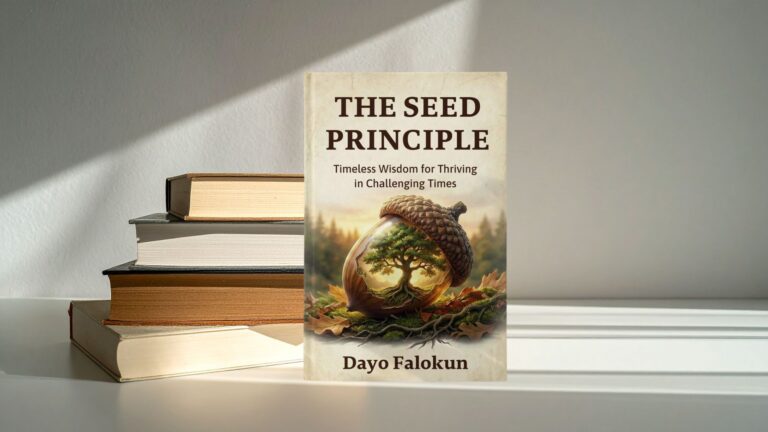
Ready to shape your future and the world? Get seeded with ideas from my new book The Seed Principle today!