

Facilitating Critical Thinking through Peer Learning
Earlier this week, my classroom hit a wall.
I had challenged my students with a business case study. After about forty-five minutes of intense, quiet struggle, one student finally threw his hands up in frustration.
“This case study is too complex!” he retorted. When I asked what the problem was, another student said, “The answers just aren’t straightforward.”
In effect, they were experiencing a cognitive brain strain: the literal “headache” that happens when your prefrontal cortex is forced out of autopilot. At that moment, I knew I needed to pause the assignment and teach them a deeper life lesson.
I took them back to 2020, participating in an online MBA class with one of my favorite Business School professors at the Lagos Business School, Prof. Yetunde. During our Analysis of Business Problems course, she introduced us to the Cynefin Framework, a model that categorizes problems into five domains: Simple, Complicated, Complex, Chaotic and Confusion (Disorder).
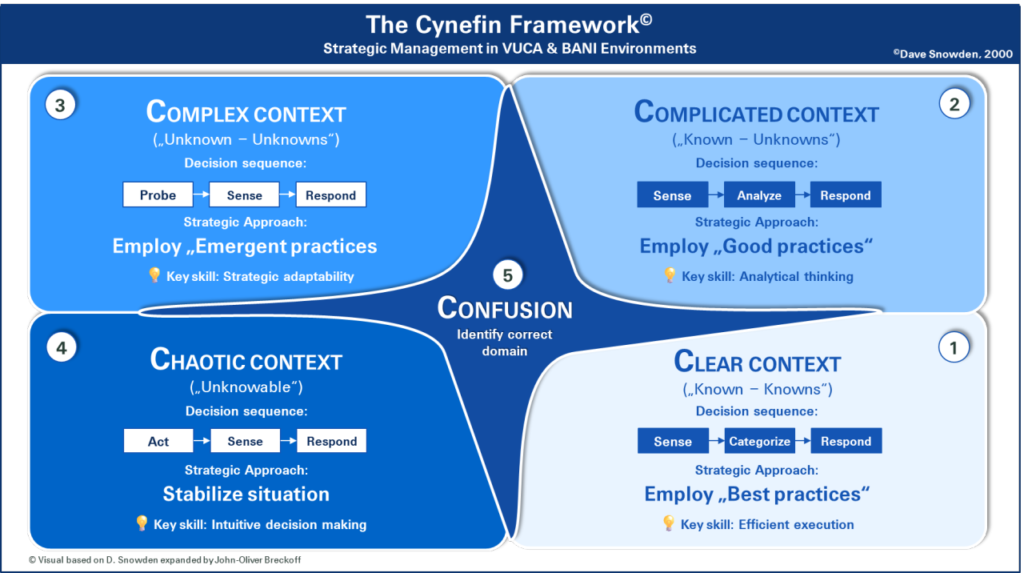
One deduction from the session which stuck with me forever is this: Many real-world problems in business and life are rarely simple or complicated. They are complex or chaotic.
In other words, they don’t have a neat, paint-by-numbers answer. They require deep critical thinking: a rigorous mental discipline that stretches our cognitive limits. That “migraine” my students were complaining about? It wasn’t failure. It was the feeling of brain cells growing.
I looked at the class and told them: “One of the most defining skills of the 21st century is critical thinking.”
In an era where AI has been democratized and basic critical thinking is being outsourced to algorithms, the individuals who choose to endure the temporary discomfort of deep thinking will become increasingly rare and immensely valuable in board rooms.
After breaking down this framework, something incredible happened. The energy in the room shifted from defeat to defiance. They didn’t just get back to work; they collaborated with a synergy and speed I hadn’t witnessed since the course began. About half an hour later, they cracked the case and had the rest of the evening chatting and having fun! (And there I was smiling with utmost satisfaction – lol).
The Key Takeaway: As an educator, parent or leader, the greatest tool you can give your people isn’t the solution to their problem. It is the motivation to believe they already possess the cognitive firepower to crack the nut themselves. The former merely gives them a fish; the latter teaches them how to fish.